


Magical Unreality on the Thames: The Story of the Venetian Fêtes at Richmond. Supplementary Material.
Updated: Apr 30

On (DATE TO BE GIVEN WHEN PUBLISHED - IN PRESS) 2026 I published a paper entitled Magical Unreality on the Thames: The Story of the Venetian Fêtes at Richmond. This describes the hugely popular Venetian river fêtes that took place between 1889 and 1911 (with a revival in 1935). The centre piece of these fêtes (from 1896) was a ‘battle’ between opposing fleets of 15-20 boats, pulled by a steamer, that would let fireworks off against each other.
The citation for the article is: George A.J.T. Magical Unreality on the Thames: The Story of the Venetian Fêtes at Richmond. Richmond History (2026) in press. For the text of the paper please see (link will be given when published - in press).
I have given a talk to the Richmond Local History Society on this topic, the video of which can be accessed here.
This blog page contains four items of supplementary information associated with the article.
1. An account of the recreation of aspects of the ‘battle’ that took place in 2025 (click here)
2. Accounts for 1911 for the fête and for wider coronation celebrations (click here)
3. A poem written in 1907 about the fête (click here)
4. An account of illuminating a house (click here)
Supplementary Information 1: Recreation of Battle
While there are pictures of much of the Richmond Venetian Fêtes there are no illustrations of the battles (though vivid descriptions are found in contemporary accounts, including a poem based on Tennyson (Section 3) that highlights the smell and smoke created). Therefore, in order to explore the nature of the battles a recreation of aspects of the battle was carried out one evening in May 2025. This involved the boat Lilian and her ship’s boat, the Lillan. The Lillan, with a crew of four, was moored between two buoys about 40 feet from the Lilian. Following a signal, the Lillan fired 4 handheld fireworks in the direction of the Lillian, the fire being returned with 2 fireworks. These were similar to Roman Candles and let of a red light followed by a shower of sparks. Following this the Lillian fire two time expired flares at the Lillan (similar to Bengal fire), this fire being returned by one flare. A full report on the recreation is given in the Appendix below.

This recreation varied from the original in several important respects. The boats were stationary, they were separated by about 40 feet rather than a few feet, and (due to improved Health and Safety regulations) the handheld Roman Candles used were considerably less powerful than would have available at the time of the river fêtes. In spite of this the reconstruction was helpful. It provided an appreciation of the complexity of organising events on the river. The vagaries of tide, wind and flow would have required skill and knowledge if the two fleets were to manoeuvre close to each other.
While limited, the display on the water was spectacular, and all those involved (letting of and observing the fireworks) found the event exhilarating and exciting. The effect that would have been produced by 30-40 boats firing at each other would have been magnificent.
For two films of fireworks please see below
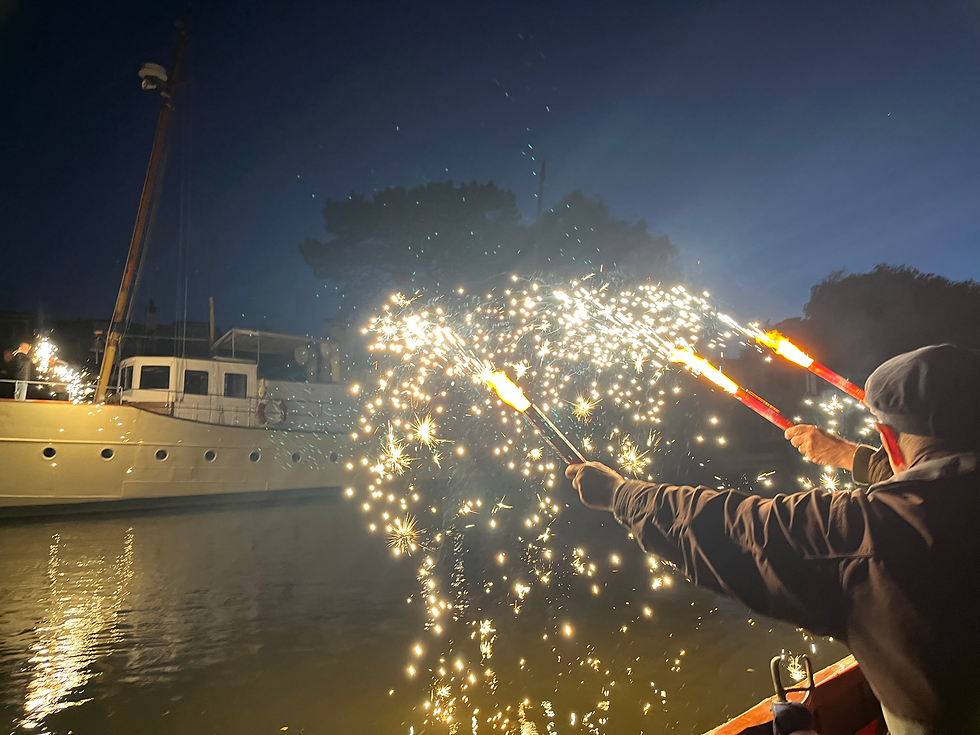

The experience of those on the Lillan also mirrored the eye witness accounts of those taking part in the real battles. At the start there was a certain amount of business to attend to in getting the boats ready and deciding what to do. Then there was a leisurely row to position in which it was possible to appreciate the lights on the river as darkness fell. While the fireworks were being let of there was a period of excitement, and attention was focussed on the fireworks – there was little awareness of anything else around. Once the flare had finished the occupants’ vision was affected due to the bright light, which explained why reports at the time described boats bumping into each other. There were also some practical lessons (including the difficulty of lighting things on a windy river, and the need for gloves).
I would like to thank Hilary Pickles and Scott Piera and the ‘crew’ of the Lilian and Lillan (Penny Pereira, Lucas Capper, Lois Capper, Clarrisa Hinken, Philippa George, Katie Urch, David Capper, Judith Baskerville and Alice Hinken) for their help with the recreation.
Appendix: Report on the recreation of the Venetian Battles at Richmond
Date 3 May 2025
Purpose
To investigate and explore some aspects of the battles that took part in Venetian Fetes in Richmond, and to obtain images and films for talks on the battles.
Location
The Yacht Lilian moored off Ducks Walk Twickenham. The Lilian has been ‘resident’ in this area for many years, however, at the end of the month it will be leaving Richmond and returning to Stockholm. The recreation involved the Lilian and also her ship’s boat (Lillan).
Crew
The recreation was planned by Andrew George (on Lillan) with the input of Hilary Pickles (on Lilian) with additional support on the day of Scott Pereira (on Lillan) and Katie Urch (on Lilian). The crew consisted of Penny Pereira (on Lillan), Lucas Capper (fireworks on Lillan), Lois Capper (fireworks on Lilian), Clarrisa Hinken (fireworks on Lilian) Philippa George, David Capper, Judith Baskerville and Alice Hinken (all on Lilian).

Fireworks
In the original battles they used hand held roman candles that projected arches of sparks and coloured explosives several metres. Health and safety regulations have changed (probably for the better). Following helpful consultation with ‘Exclusive Fireworks’ of Hounslow Andrew George purchased 6 Trafalgar Red Flares. These are available in other colours. They give around 15 seconds of red colour, followed by about 45 seconds of a fountain of sparks. They do not make a noise. These are designed to be hand held. They are almost certainly smaller and less powerful than the roman candles used in the battles.
We also used 3 time expired emergency flares from the Lilian. These are probably equivalent to the Bengal Fire.
Regulations
It should be noted that the Port of London Authority are hoping to change their regulations so it would not be permitted to let off fireworks on the Thames without their prior approval. At this date it was still permissible.
Health and safety
All those on the ships boat wore life jackets. One person on the ships boat was designated not to be letting off fireworks so that they could have oversight. Fireworks let off from the Lilian had adult supervision. Hilary Pickles and Andrew George discussed safety aspects.
What happened
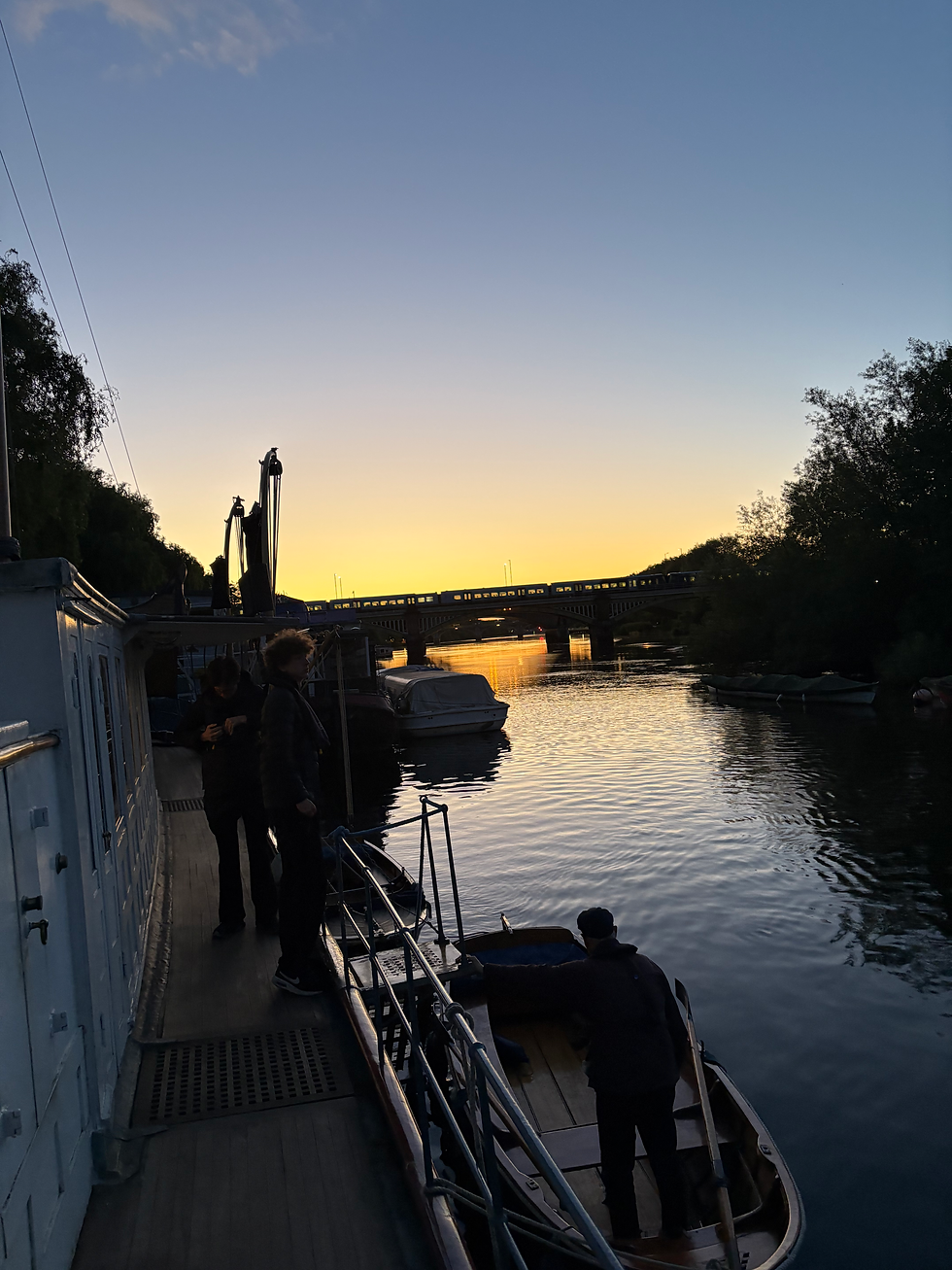
The experiment took place around 8.30 when people started to get ready. We rowed out around 8.45 and the fireworks were let off around 9. The light was falling rapidly. The tide had already turned at this time, but was not running fast. The ships boat was tied stern and aft on buoys, and lay approximately parallel to the Lilian, about 40 feet away. There was a moderate wind.
SP was in charge of the rowing boat. AJTG was on the rowing boat and oversaw/coordinated the letting off of fireworks. CEU oversaw fireworks on the Lilian.
There were 4 Trafalgar Red flares on the Lillan, and 2 on the Lilian. There were 2 time expired nautical flares on the Lilian and one on Lillan.
On a signal from AJTG the Trafalgar Red flares were all lit and pointed at the opposing vessel. Films and photographs were taken. When that was done the nautical flares were let off.
The Trafalgar Red flares worked well. The main technical issue was getting them alight – it turned out that matches on a windy boat does not work well! The wind was also a factor in blowing the sparks onto the people holding the flares on the boat, which caused some discomfort.
The nautical flares were spectacular, but while they were designed to be hand held, they got hot and the two on the Lilian were quickly dropped in the water. The one on the Lillan lasted longer but also had to be discarded over the boat. Once in the water they kept bubbling and ‘burning’ for a time.

The effects
It was interesting being on the river in the half-light. As the light fell the artificial lights on Richmond river front became much more prominent. It did feel magical and fairy light, and rowing a boat in the half dark was an interesting prelude.
The effect of the Trafalgar Red was quite spectacular. At the start the flares were red, and it looked good but not particularly interesting. However, as soon as it started to eject stars and sparks then from both the boat and the Lilian there was a really good cascade of sparks. From the inside of the boat Lillan one saw the shower of one’s own sparks like a curtain. Because of the brightness of the fireworks one saw little else, and really focussed on the lights. I lost situational awareness, and really only saw the fireworks.
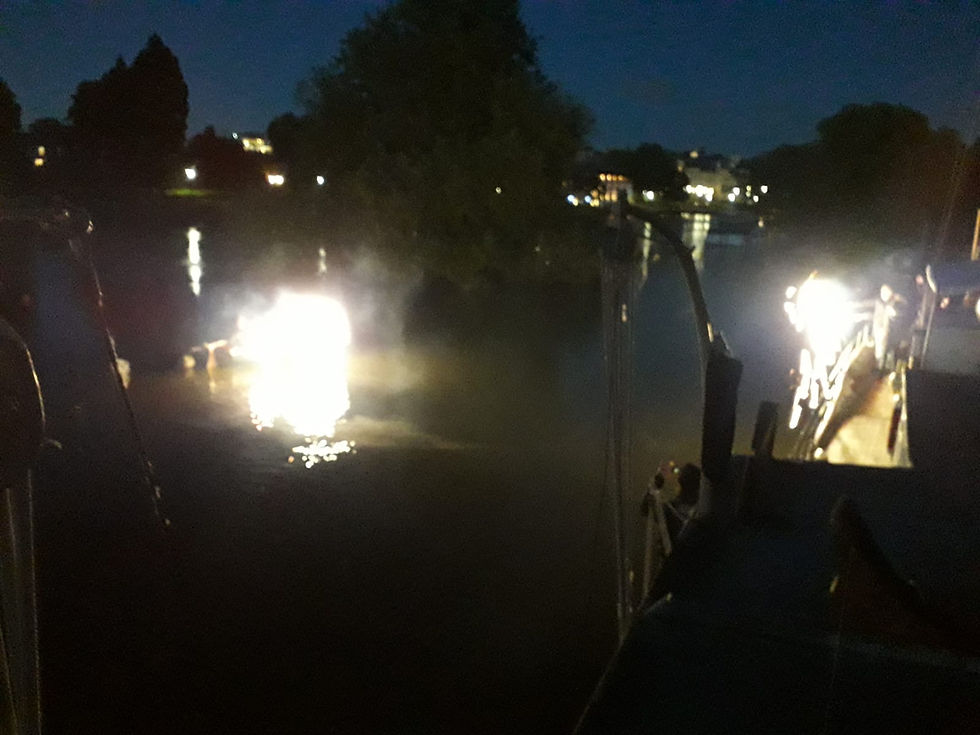
The flares were spectacular, though more short lived than hoped! They gave out a lot of smoke, and the overall effect was to make the ship's boat almost seem on fire, as the smoke over the boat was lit up with red. It also cast a light on the surroundings that was quite magical.
After the display, those on the boat found it difficult to see as their vision had adapted to the fireworks. This lasted some time, and explains why the sailors of the original boats complained that they could not see unlit boats on the river.
At the end all those involved, both spectators and those letting off the fireworks felt a sense of exhilaration and excitement. There was a lot of animated talking, comparing experiences etc.
Lessons
For a landlubber, I came to appreciate the difficulties of putting on such an event on the river. One needs to consider tides, water flow, wind. While this would have been easier once the Richmond Lock was in operation. However, it made me realise that towing a train of 15-20 boats and then engaging with an enemy fleet would have required a high degree of boatmanship.
The reports of those on the boats, there being activity of getting things ready in the half-light, of interest looking around, and then once the roman candles were let off a narrowing of the focus onto the ‘action’ , followed by excitement and elation after was similar to what we experienced.
The battle would have been incredibly impressive. One boat letting off 4 candles produced an exciting show. What would 40 boats doing it all together been like?!
Lighting the flares required more thought.
Gloves should have been provided.
Supplementary Information 2: Costs of the fête
The costs of the fête in 1911 are show in the tables below, together with the costs of other events that were put on to celebrate the coronation, and the income used to pay for it. Overall the direct costs of the water fête were £382.7.4, the vast majority of which was for fireworks (presumably including the costs of ammunition for the battle). This is the equivalent of £39,000 in 2025.
Finances of the Coronation Celebrations in 1911 showing the expenses for the river fête (1), the summary costs of the main components of the festivities (2) and the income (3).
Table 1 Expenses for the River Fête, 1911
| £ | s | d |
Boats and Launches | 43 | 8 | 0 |
Lanterns and Electric Light | 14 | 3 | 0 |
Bands | 15 | 16 | 3 |
Prizes | 12 | 15 | 6 |
Buccleuch House Expenses | 15 | 0 | 0 |
Assistance, Police, Watermen and Men for Coloured Fires | 16 | 18 | 5 |
Fireworks and Illuminations | 250 | 0 | 9 |
Refreshments | 3 | 15 | 3 |
Honorary Secretaries’ Disbursements | 3 | 5 | 8 |
Expenses provided by the Mayor | 4 | 14 | 6 |
Total | 383 | 17 | 4 |
Table 2 Expenses for Coronation Festivities, 1911
| £ | s | d |
Old Deer Park (event for aged poor and children) | 181 | 13 | 0 |
Entertainment to School Children | 141 | 4 | 6 |
Sports and Procession | 220 | 17 | 11 |
River Fête | 382 | 17 | 4 |
General Expenditure (including advertising and postage) | 106 | 10 | 3½ |
Balance to carry forward | 2 | 16 | 8 ½ |
Total | 1015 | 19 | 9 |
Table 3 Receipts for Coronation Festivities, 1911
| £ | s | d |
Balance carried forward from 1907 | 13 | 9 | 0 |
Public Subscriptions | 719 | 0 | 0 |
Mayor’s contribution to children’s entertainment | 141 | 4 | 6 |
Mayor’s contribution to river fête | 4 | 14 | 6 |
Rent of ground | 100 | 0 | 0 |
Permission to sell refreshments | 26 | 0 | 0 |
Chairs and dance enclosure | 9 | 11 | 9 |
Sale of cannon | 2 | 0 | 0 |
Total | 1015 | 19 | 9 |
Details from 1911 scrapbook.
Supplementary Information 3: Poem
This poem was published in The Richmond and Twickenham Times. Prof Democritas Dart at Home, Local Chit-Chat. 27 July 1907, Pg 6.
Charge of the Vauxhall Light Brigade
I
After nine, After nine,
After nine, onward,
All in the Valley of Thames
Towed the half-hundred
“Forward the Light Brigade!”
Small and big ‘UNS” he said;
Into the Valley of Thames
Towed the half -hundred.
II
“Forward the Light Brigade!”
Was there a man dismayed?
Not though subscribers knew
Someone had blunder’d:
Their’s not to make reply,
Their’s but to reason why
There they were, much too high,
High up the Valley of Thames
Having been plunder’d.
III
Rockets to the right of them,
Rockets to the left of them,
Rockets in front of them
Fizzled and thunder’s
Stormed at with shot and shell,
Boldly they towed, and well,
While they all held their breath
Midst that most awful smell,
Towed the half-hundred.
IV
Flashed all their candles there,
Flashed as they burn’d in air,
Lighting the valley there
Bright as at noonday, while
All the folks wonder’d:
Plugged up their eyes with smoke,
Right through the foe they broke;
Dinghey and randan
Reel’d from the thunder-stroke,
Shaking and sunder’d:
Hot, that half-hundred.
V
Red fire ahead of them,
White fire to left of them,
Rockets behind them
Fizzled and thunder’d;
Choked by the sulphur smell,
While sparks and [?]willow fell,
They that had towed so well
Came, holding still their breath,
Back through that awful smell,
All that was left of them,
Chocking half-hundred.
VI
When can their glory fade!
(No charge for lamps was made)
All the folks wonder’d
Honour the noise they made!
Honor the Light Brigade,
Grimy half-hundred!
Notes
Verse 2 was attempting to humorously suggest that some of the subscribers did not have as good a view of the event as their donations warranted.
A randan is a type of skiff.
Supplementary Information 4: Account of illumination of house
This is taken from an article by John Cloake (Richmond's Victorian River Fetes: The Recollections of Godfrey Hertslet). Richmond History (1996) 17: 38-41) which contains extracts of the memoires of Godfrey Hertslet who was the son of Sir Edward Hertslet, who lived in Belle Vue House on Petersham Road. This extract describes the illumination of the house. The decorations at Belle Vue were considered by newspaper accounts to be the best! This article is not widely available, so I have reproduced it as it provides a different perspective on the event. Sir Edward and Godfrey and four generations of the Hertslet family were librarians in the Foreign Office.
Belle Vue House, and grounds, was well adapted for illuminations when fêtes were arranged at Richmond on the river Thames. There was a balcony running the length of the house at the back, facing the river, and there were four steep banks of grass, each with a path at the top, with many standard rose trees. At the bottom of the garden was a tennis lawn, with a gravel path at the river end of it, and the wall along the towing path was of brick, covered with ivy. We had a high flagpole fixed to the wall.
For illuminations we used Chinese lanterns and hundreds of Vauxhall lamps (small glass buckets of various colours). In the Chinese lanterns we used candles, and in the lamps small wax discs like the regulation night lights. To prevent the lanterns from swinging in the wind, we weighted each with sand. Each Vauxhall lamp had to be wired for hanging, and for being attached to the balcony rail, or other places, and they had rounded bottoms so could not stand unless supported.
For the flagpole, we used light chains to make a double festoon of lamps which were fastened to chains. One festoon was hauled to the top of the flagpole, and the second to about three quarters of the way to the top.
The lamps had to be lit while the festoons were raised by halyard. It was quite a job, for several of us, to get the festoons decorated, the lamps lit, and raised to their proper position. Of course, the ends of each festoon were securely fastened, at some distance from the flagpole, to the garden wall. When all this was done, and many lines of Vauxhall lamps placed along the balcony, roof, etc. of the house, and along all the banks, the effect was strikingly effective.
The preparations for each fête kept us well occupied for days, and we were aided by friends who willingly gave us their assistance.
Practically all the houses and grounds bordering on the towing path, from the bridge (which was also lined with colour lights) to the turn at Buccleuch House, were illuminated in a similar way, but I think that ours was the best. At least it should have been, considering the work we did to make it look its best. We all gave parties for the fêtes and entertained many guests.
On the river itself were many small boats, each one trying to outdo its rivals in the matter of illumination.
When the fêtes were in full swing, it was a brilliant spectacle and immense crowds thronged the towing path. This gave pickpockets a golden opportunity of reaping a rich harvest, and scores of empty purses were found on the towing path the morning after ....
On June 27, 1891, my coming-of-age birthday, a most successful Floral River Fête was held. Naturally it was merely a coincidence that this date was selected, and it was a good opportunity for a garden party that we took full advantage of, as did other riverside residents. On that occasion the small boats on the river were beautifully decorated with flowers of all kinds ....
We always secured the services of a Policeman in uniform, who was specially permitted to do this duty in his leisure time, to keep the garden gate and to allow only authorised persons, but we allowed the Policeman some discretion in admitting friends who had not received invitations to view the fêtes from our grounds. If we had not adopted this precaution we would have been swamped by the influx of sightseers from the crowd that swarmed on the towing path, and our own invited guests would have been victims of pickpockets.
As is usual with nightlights, many of the Vauxhall lamps continued burning long after the majority had burnt out, but we did not attempt to extinguish them and let them go on to their end.
One day it rained in torrents and filled the lamps with water after they had been placed in position reading for lighting. We had to empty out as many as we could, and dip the wicks in paraffin before we could light them. We could only do this to a limited number, but we managed to put on a good show in spite of the handicap.
This extract reproduced with permission of Richmond History.
Photographs of recreation, copyright (c) 2026 Andrew JT George
text copyright (c) 2026 Andrew JT George


Comments