


Royal Naval Female School in St Margarets
Updated: Jul 30, 2025

On August 31st the Royal School in Haslemere will close. This may seem of no relevance to St Margarets, but for much of the school’s history it was the Royal Naval Female School based in what is now the Richmond Lock Development.
The School was founded in 1840 in a house on Richmond Green for the daughters of officers of the Royal Navy and Royal Marines. These men had often been placed on half pay following the end of the Napoleonic Wars, and their daughters could be in a financially precarious position. The aim was to educate them to have ‘suitable’ jobs, such as being teachers and governesses. It was highly successful, and soon needed larger property [i].
The 2nd Earl of Kilmorey, who was notorious for having eloped at the age of 56 with the 20 year old Priscilla Hoste, purchased Gordon House and St Margarets House in 1851. He proceeded to demolish St Margarets House and in its place built a palatial home for himself, Priscilla and their son, Charles. This grand building, which faced what is now Pomeroy Close, was 154 feet and 6 inches long and 57 feet 6 inches deep, costing a total of £16920 (around £1.7 million pounds today). It was designed by Lewis Vulliamy who was also the architect for Hickey’s alms-houses and St John the Divine Church. Remarkably it was completed by 1852 [ii].

Unfortunately Priscilla fell ill and they never lived in this house. She died in 1854 and was laid to rest in the magnificent mausoleum that is now on St Margarets Road. Kilmorey sold the building and the land around it to the Conservative Land Society, who laid out the St Margarets Trust Grounds. They sold St Margarets House to the Royal Naval Female School in 1856.

St Margarets House (known as Kilmorey House by the school) provided a rather grand setting not only with a rather commanding position on the river, but also in the hall used for assemblies. Individual classrooms looked slightly odd, crammed into domestic rooms.
The School thrived on its in its
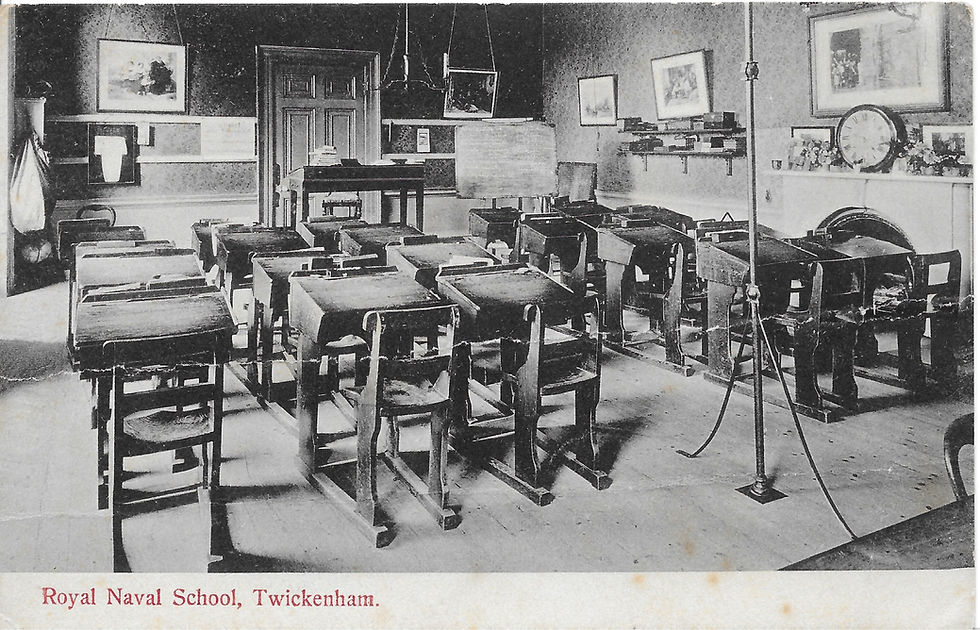
new location, and had considerable Royal patronage. In 1923 the School expanded to include Gordon House (which had previously been an Industrial School for girls). They also owned a building on the Trust Grounds traditionally known as Ormonde House (but recently named River Grounds Manor House) as one of the boarding houses (Hood House).
Postcards of the school show the young girls gardening, relaxing on the lawn and playing badminton or tennis. Contemporary accounts suggest they were very active, with trips to see events in London, sports events and school plays.

The school stayed in St Margarets until World War II. Lord ‘Haw-Haw’ (William Joyce who broadcast propaganda from Germany) announced that the school was a target (‘we are sorry to have to bomb the Naval School – so upsetting for the fathers at sea’). In 1940 a number of bombs fell in the school site causing some damage, and the school was evacuated to Verdley Place between Fernhurst and Midhurst. On the 29th November Kilmorey House was set ablaze by incendiaries, and then directly hit with an high explosive bomb [iii]. The remains of the building were demolished after the war [iv].

After a couple of years the school moved to the recently vacated Stoatley Hall, high above nearby Haslemere. Royal patronage, which began in the 1890s, continued and both Queen Elizabeth the Queen Mother and Queen Elizabeth II were patrons until their deaths. The Princess Royal took over the Presidency from Lord Mountbatten of Burma in 1975, continuing until the closure of the school. Some of the traditions of the school can be traced to its time in St Margarets: one of the houses was called Kilmorey and the sanitorium was named Canada as it was in St Margarets. There was also a Kilmorey bursary funded by old girls of the school. One of the rooms in the school has an elaborate fireplace and plasterwork ceiling similar to those in Gordon House designed by Robert Adam, the renowned Scottish designer and architect.

In 1995 the Royal Naval Female School merged with The Grove School, to become the Royal School. It became co-educational in 2019, when it also joined a charitable trust (United Learning). It will close in August 2025 due to falling numbers over recent years.
In St Margarets there are still some reminders of the School. Gordon House is now a private house in the Richmond Lock Development. The chapel that was built in 1868 for the school on Kilmorey Road (sometimes called the Violet Needham Chapel after the author who was the Earl of Kilmorey’s granddaughter) is now a dance studio for the Rambert School of Ballet and Contemporary Dance. The weather vane on top of the Chapel tower is of naval design, so the arrow points to where the wind is blowing to rather than where it is coming from – though the letters showing the points of the compass have now fallen off.
The Rambert School also occupies Clifton Lodge, which was named after the first Lady Governess, Miss Clifton. She was in charge for 30 years, and was thought of by the girls as a wise and kind person whose ‘heart [was] mother to them all’.
Interestingly this part of St Margarets has been a centre for women’s education. In addition to the Royal Naval Female School there was the Industrial School for girls in Gordon House. After the Royal Naval School left the site was taken over by the Maria Grey Training College, possibly the first teacher training college for women.
While the closure of a school in Haslemere may be seem of little consequence to St Margarets, it does provide an opportunity for us to reflect on our history and the impact this area will have had on generations of girls who were educated here.
Acknowledgements
I would like to thank Caroline Scallon for sharing her knowledge of the Royal School. All pictures are from postcards are in the personal collection of the author, some courtesy of Alan Winter.
Notes
[i] For a history of the Royal Naval School until 1975: Unwin, P. (1976). The Royal Naval School 1840-1975. Sevenoaks: The Longmore Press. The School had various names during the period they were in St Margarets, the official name for much of this time was The Royal School for the Daughters of Officers of the Royal Navy & Royal Marines.
[ii] For a full account of the Earl of Kilmorey; George, A. J. T. (2024). Francis Jack Needham, the 2nd Earl of Kilmorey; His Life and Loves. Twickenham: Habitats & Heritage. For more about the house he built; George A.J.T. (2025). The Gardens and People of Twickenham Park. Bristol: Redcliffe Press (this will be published in November 2025).
[iii] An account of the bombing and evacuation of the school, and the heroic attempts by the teachers to save the building, makes compulsive reading: see here.
© 2025, Andrew George, all rights reserved
Published 22 July 2025


Comments